Choosing an eCommerce platform is less about finding a universal winner and more about understanding how your business needs to operate.
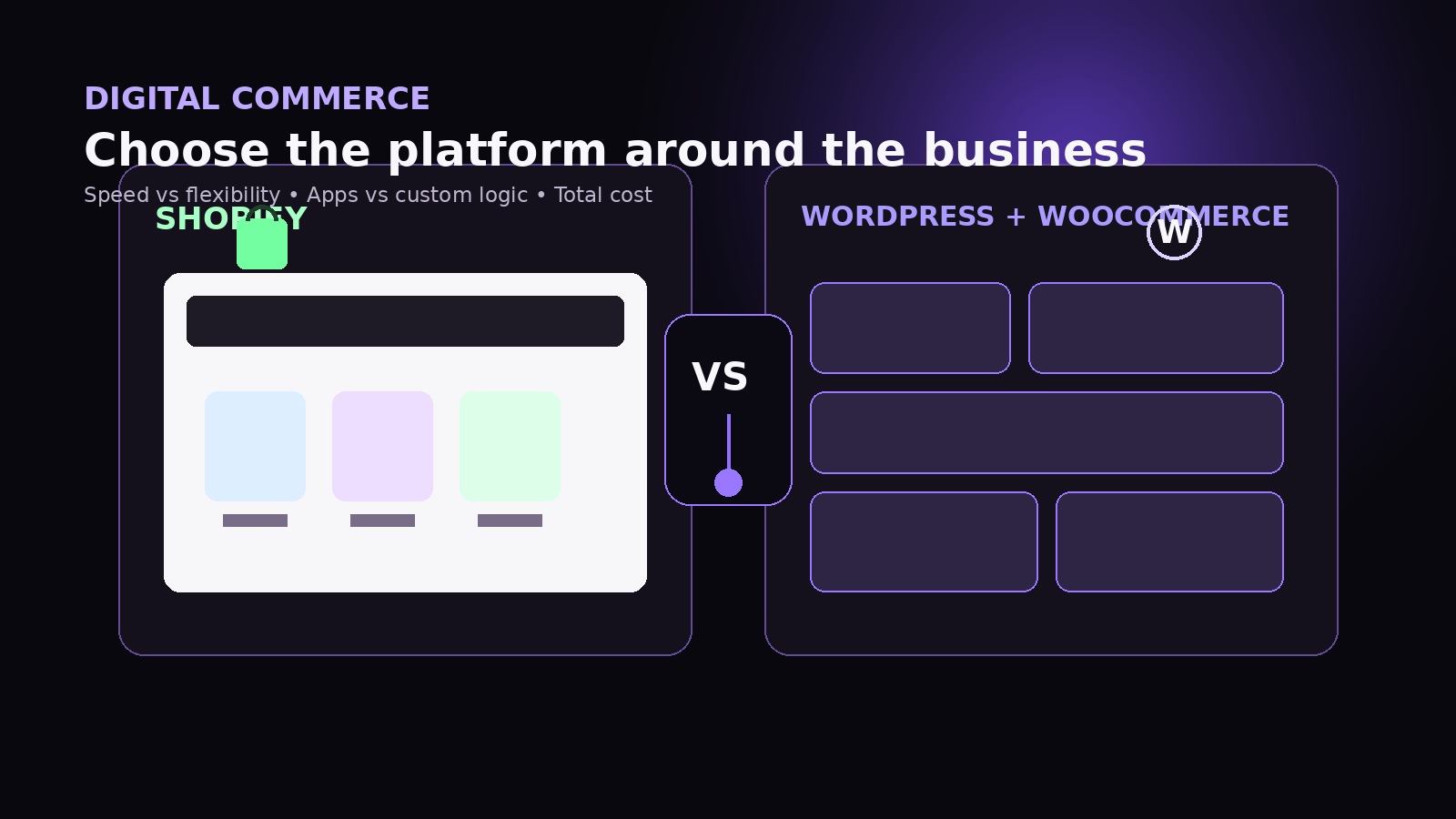
Shopify and WooCommerce are both established options, but they make different trade-offs. Shopify provides a tightly managed commerce environment, while WooCommerce gives businesses more control over the website, data model and custom functionality.
When Shopify is the better fit
Shopify is often attractive when a business wants to launch quickly and prefers a managed platform.
Hosting, security updates and much of the infrastructure are handled by Shopify. The administration experience is consistent, and there is a large ecosystem of apps for common retail requirements.
Shopify can be a strong choice when:
- The store follows relatively standard eCommerce workflows
- The team wants minimal server administration
- Speed of launch is more important than deep backend customization
- Most required functionality is available through Shopify or established apps
- The business is comfortable operating within the platform's architecture
The important point is to review app costs and limitations early. A store that needs many third-party apps can become expensive or operationally complicated over time.
When WooCommerce makes more sense
WooCommerce runs on WordPress and provides greater control over the application itself. Developers can modify checkout logic, product structures, integrations and workflows without being limited to the same extent by a hosted platform.
WooCommerce is particularly useful when:
- Content and commerce need to work closely together
- The business requires custom product or pricing logic
- There are complex integrations with CRM, ERP or internal systems
- The company wants greater ownership of its hosting and codebase
- Existing WordPress functionality needs to be extended into commerce
That flexibility also means the business is responsible for making good decisions around hosting, performance, security and plugin quality.
Think about the operation, not only the storefront
The most visible part of an eCommerce project is the storefront, but the operational workflows behind it often determine the correct platform.
Consider how orders move through the business. Do prices change based on customer type? Do products have unusual configurations? Does inventory live in another system? Are there subscriptions, wholesale customers, booking rules or complex shipping requirements?
A visually simple store can still have complicated business logic.
Total cost is more than the monthly subscription
Platform comparisons often focus on subscription fees, but a useful cost analysis should also include:
- Development and customization
- Third-party applications or plugins
- Maintenance and support
- Payment processing
- Hosting and infrastructure
- Internal administration time
- Future feature development
A cheaper starting point can become expensive if the platform requires workarounds for core business requirements.
Choose around the next two to three years
A good eCommerce platform should solve today's problem without making tomorrow's roadmap unnecessarily difficult.
If your priority is a managed commerce experience with standard workflows, Shopify may be the faster route. If your competitive advantage depends on custom workflows, content, integrations or ownership, WooCommerce may provide the flexibility you need.
At KoderNext, we normally make the platform decision after understanding the product catalog, customer journey, integrations and growth roadmap. Technology should support the business model—not force the business model to adapt around the technology.