AI development cost is easy to underestimate because the model API is visible and the surrounding engineering is not.
A business may calculate how much it costs to send prompts to a language model and assume that represents the AI project budget.
In production, the model is only one component.
For organizations in the USA, Canada, Saudi Arabia, UAE and wider GCC, a realistic AI budget should include data, integrations, evaluation, security and ongoing monitoring.
Start with the use case
“Build an AI platform” is not a scope.
Useful AI projects begin with a defined workflow.
Examples include:
- Internal knowledge search
- Customer support assistance
- Document extraction
- Sales research
- Proposal generation
- Lead qualification
- Workflow automation
- AI agents
- Intelligent search
The cost depends on what the system must do around the model.
The model is only one cost layer
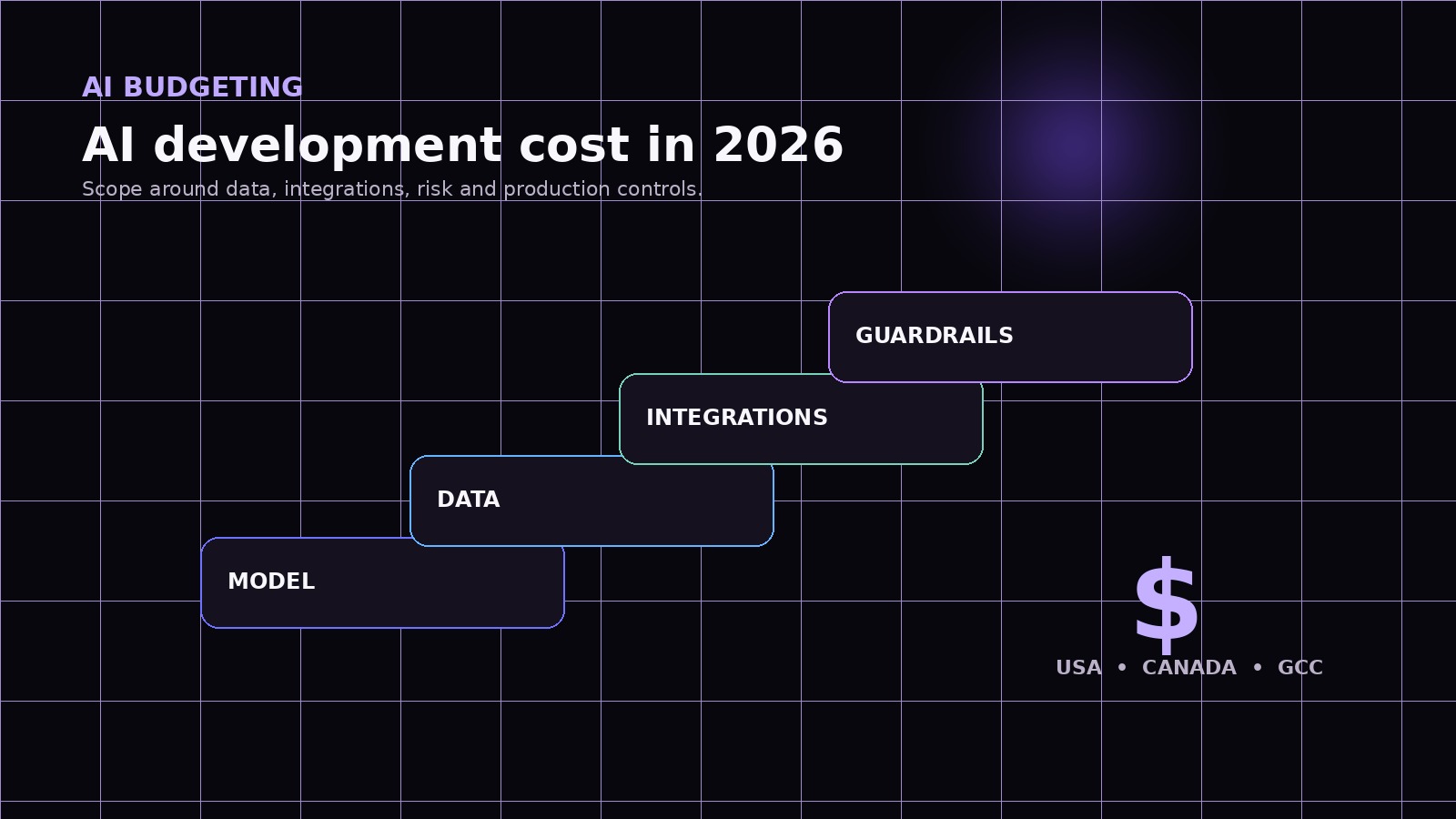
A production AI application may include:
- User interface
- Backend
- Model API
- Prompt and tool orchestration
- RAG pipeline
- Vector database
- Authentication
- Role permissions
- Business integrations
- Evaluation
- Logging
- Guardrails
- Monitoring
A proof of concept can skip some of these layers.
A customer-facing production system cannot.
Data preparation can be significant
AI quality depends on data quality.
For a RAG system, documents may need to be:
- Collected
- Cleaned
- Categorized
- Split into useful chunks
- Tagged with metadata
- Assigned permissions
- Re-indexed when changed
If business knowledge is inconsistent or outdated, the AI system will reflect those problems.
Data preparation should be included in the project plan.
Integrations often drive complexity
An AI agent becomes much more useful when it can work with business systems.
That may include:
- CRM
- ERP
- Support desk
- Calendar
- eCommerce
- Payments
- Document storage
- Internal APIs
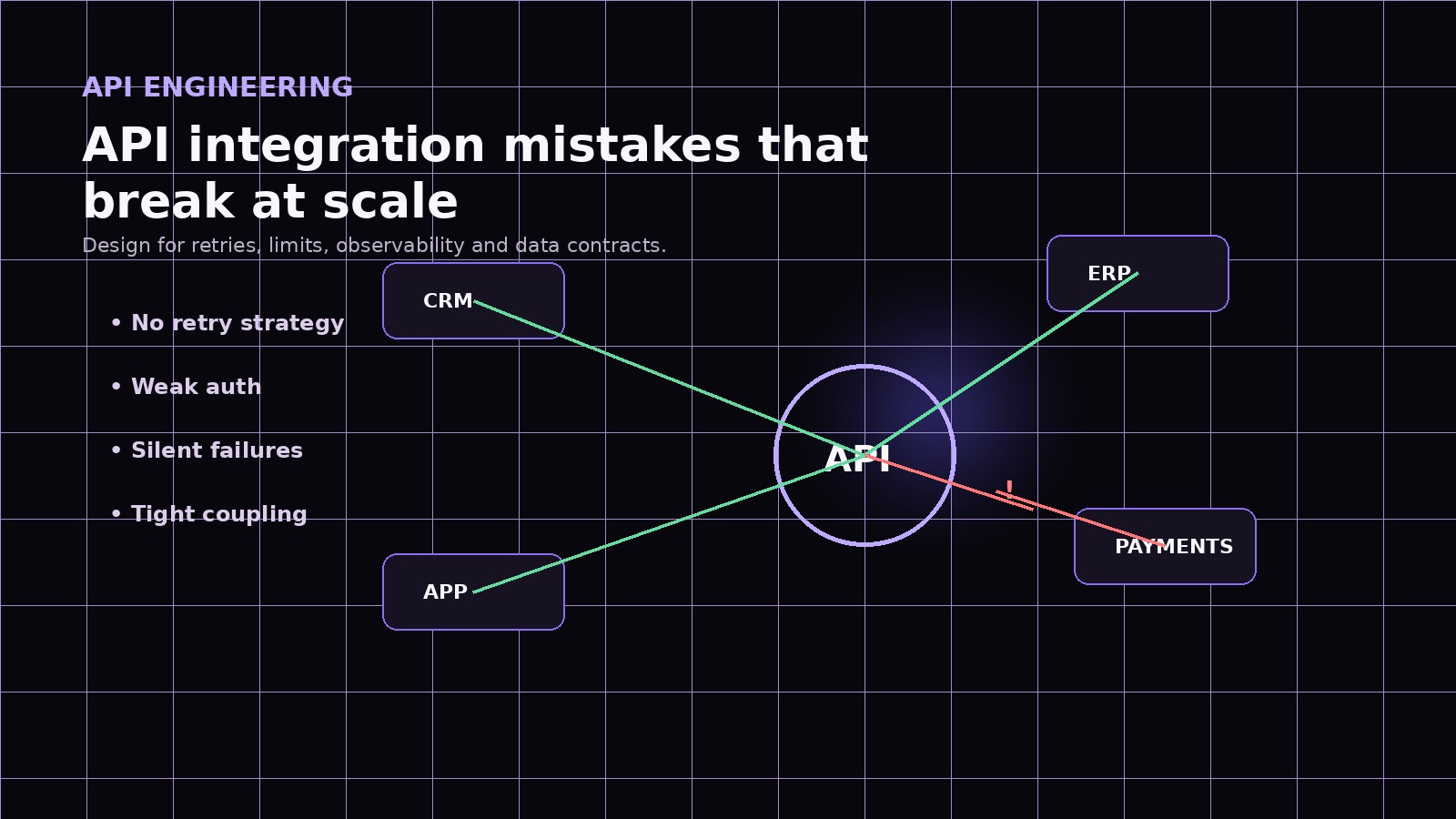
Each integration adds authentication, data mapping, error handling and testing.
The cost is therefore influenced by the environment around the AI.
RAG and agents have different architecture requirements
A simple RAG assistant may retrieve information and answer questions.
An AI agent may:
- Choose tools
- Perform multiple steps
- Create or update records
- Pause for human approval
- Resume a workflow later
The second architecture requires more controls.
This is why “agent” projects should not be priced like chatbots.
Evaluation is part of development
AI systems do not behave like traditional deterministic functions.
Teams need a way to measure whether output is acceptable.
Evaluation may include:
- Accuracy
- Retrieval relevance
- Hallucination rate
- Citation quality
- Tool selection
- Policy compliance
- Human correction rate
The evaluation process itself requires engineering and domain input.
Security changes the budget
AI systems often touch private business data.
Security requirements may include:
- Role-based access
- Data isolation
- Prompt injection defenses
- Tool permissions
- Audit logs
- Data retention controls
- Vendor configuration
- Human approval
For enterprises in the USA and Canada, security review may involve IT and compliance teams.
For GCC organizations, data residency and regional hosting requirements may also influence architecture.
Geographic rates are only part of the comparison
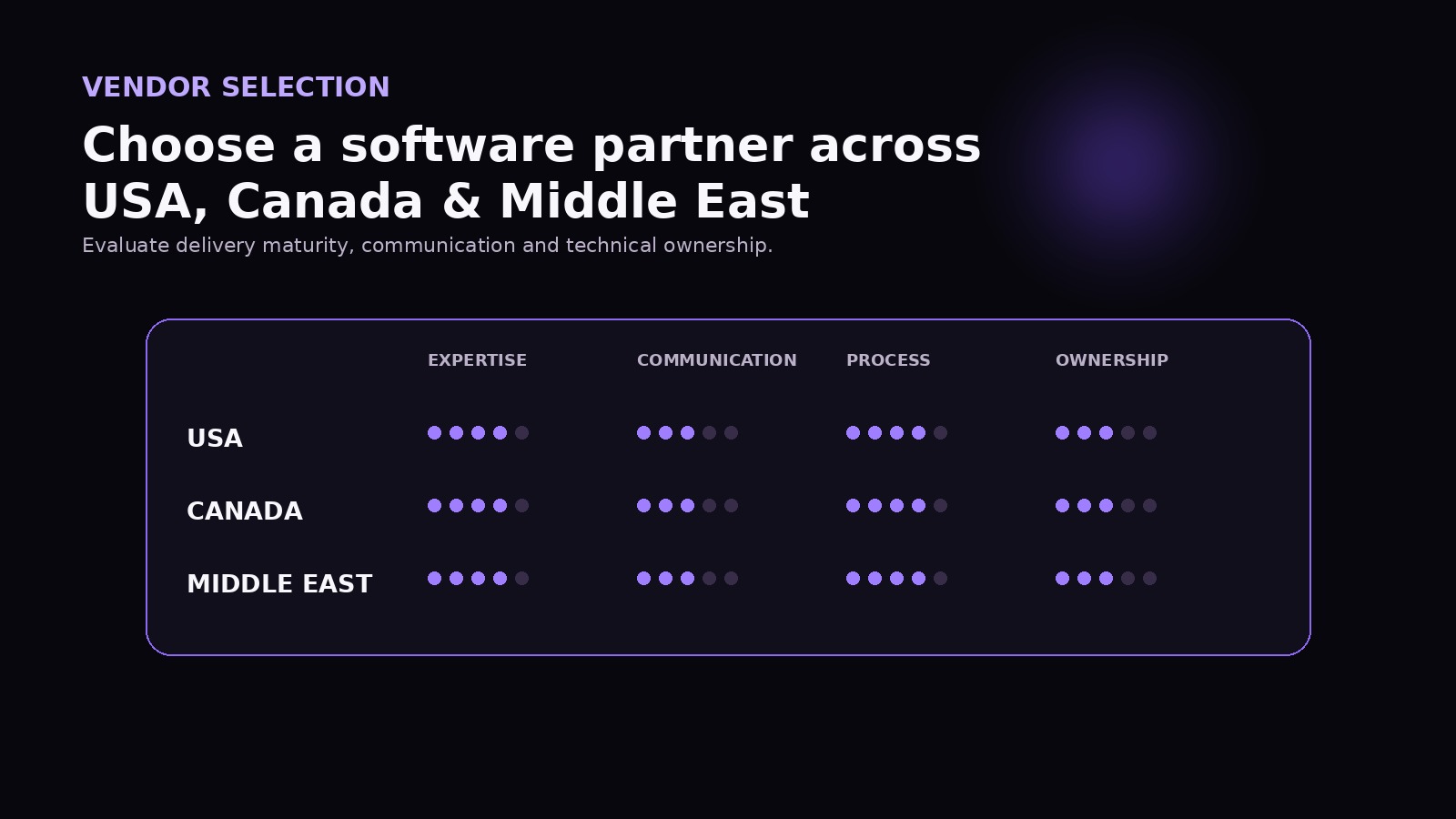
Development rates vary across the USA, Canada and Middle East, but delivery structure matters more than geography alone.
A blended team with senior architecture and distributed engineering can be more efficient than using only one region.
Compare:
- Seniority
- Ownership
- Communication
- Evaluation discipline
- Integration experience
- Security practices
The cost of reworking an unreliable AI system can exceed the original development difference.
Plan for model usage after launch
AI applications have ongoing usage costs.
These may include:
- Input and output tokens
- Embeddings
- Vector storage
- Search
- Cloud services
- Logging
- Monitoring
Usage cost should be modeled against expected volume.
A support assistant handling 100 conversations per month has different economics from a system processing millions of documents.
Start with a measurable pilot
The best way to control AI development cost is to reduce uncertainty.
Select one workflow and define success metrics.
For example:
- Reduce research time by 50%
- Improve support response speed
- Automate extraction with a target accuracy
- Reduce manual lead qualification
- Increase knowledge search success
Build the smallest system that can prove or disprove the value.
Then expand based on measured results.
Budget for a product, not a demo
A demo shows that a model can produce impressive output.
A production AI product proves that the system can operate safely, reliably and economically.
That difference is where most of the real engineering cost lives.