Staff augmentation and dedicated development teams are often presented as similar services.
They are not.
Both models give a company access to external technical talent, but the difference is where delivery ownership sits.
Understanding that difference helps businesses choose the right model for a roadmap.
What staff augmentation means
Staff augmentation adds individual professionals to an existing team.
The client usually owns:
- Product direction
- Sprint planning
- Technical leadership
- Task assignment
- Team coordination
The external developer works inside that structure.
This model is useful when an internal engineering organization already exists but needs more capacity or a specialized skill.
Examples include:
- Adding a senior React developer
- Adding a QA engineer before a major release
- Bringing in a WordPress specialist
- Filling a temporary backend gap
- Adding mobile expertise to an existing product team
The client remains responsible for managing the work.
What a dedicated development team means
A dedicated team is closer to an external product unit.
The team may include:
- Frontend engineers
- Backend engineers
- QA
- Product or business analysis
- Technical leadership
- Delivery management
The client still owns business priorities, but the partner takes more responsibility for execution.
This model is useful when the client needs sustained delivery capacity without managing every individual task.
The key question: what do you want to manage?
If your internal team already has strong engineering leadership, staff augmentation may be efficient.
You can add people directly into the existing process.
If the organization does not want to manage multiple external engineers individually, a dedicated team can provide more structure.
The partner can own more of:
- Technical planning
- Estimation
- Sprint execution
- QA
- Architecture
- Delivery reporting
The model should match the client's management capacity.
Staff augmentation gives granular flexibility
One advantage is precision.
A company can request exactly the role it needs.
For example:
- One senior Node.js developer
- One React developer
- One automation QA engineer
This can be cost-effective when the internal team knows how to use the capacity.
The risk is that adding more individuals also increases management overhead.
Five external developers are not automatically a coordinated team.
Dedicated teams improve delivery cohesion
A dedicated team can be designed around the outcome rather than individual job descriptions.
The frontend, backend and QA resources work under one delivery structure.
This can reduce handoff problems.
It also gives the vendor more responsibility for making sure the team functions as a unit.
Which model is better for startups?
It depends on the founders.
A startup with a strong CTO may prefer staff augmentation because product and engineering leadership are already internal.
A non-technical founding team may benefit more from a dedicated product team that includes technical leadership.
The development model should complement the capabilities the company already has.
Which model is better for enterprises?
Enterprises often use both.
A digital team may augment individual roles for a program that already has internal governance.
Another business unit may outsource an entire application stream to a dedicated squad.
The decision can vary project by project.
Regional delivery can be blended
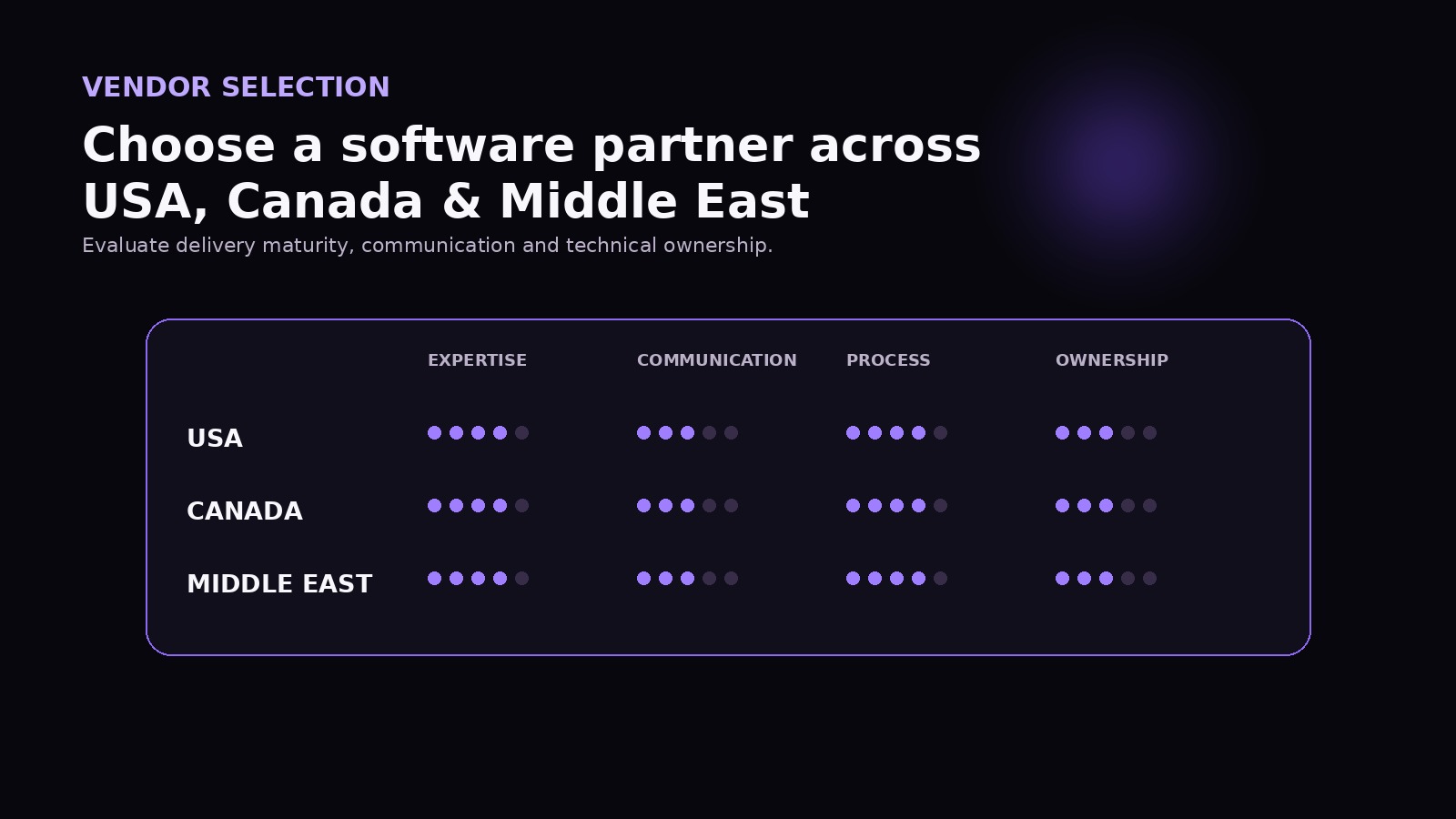
Companies in the USA and Canada frequently combine local product ownership with distributed engineering.
Organizations in Saudi Arabia, UAE and the wider Middle East may use a similar model with local account management and remote development capacity.
This creates access to a broader talent pool while maintaining business communication in the client's time zone.
The important factors are:
- Communication overlap
- Clear ownership
- Security
- Delivery governance
- Team continuity
Geography alone does not define quality.
Compare engagement models using outcomes
Do not compare only daily or hourly rates.
Consider:
- How much management time the client must provide
- Whether technical leadership is included
- QA responsibility
- Delivery predictability
- Team continuity
- Knowledge retention
- Scaling speed
A cheaper individual resource may not be cheaper if internal managers spend significant time coordinating the work.
When to choose staff augmentation
Staff augmentation is usually a strong fit when:
- You already have a product and engineering process
- You know exactly which skills are missing
- Internal leadership can manage the work
- The need may expand or contract quickly
When to choose a dedicated team
A dedicated team is usually stronger when:
- You need a complete delivery capability
- The roadmap is ongoing
- Multiple technical disciplines are required
- You want the partner to own execution
- Internal management capacity is limited
The models can evolve
A company may begin with one augmented engineer.
As the roadmap grows, the engagement can evolve into a dedicated squad.
The commercial model should support the stage of the product.
The right question is not “which model is better?”
It is “how much delivery ownership do we want the external partner to take?”