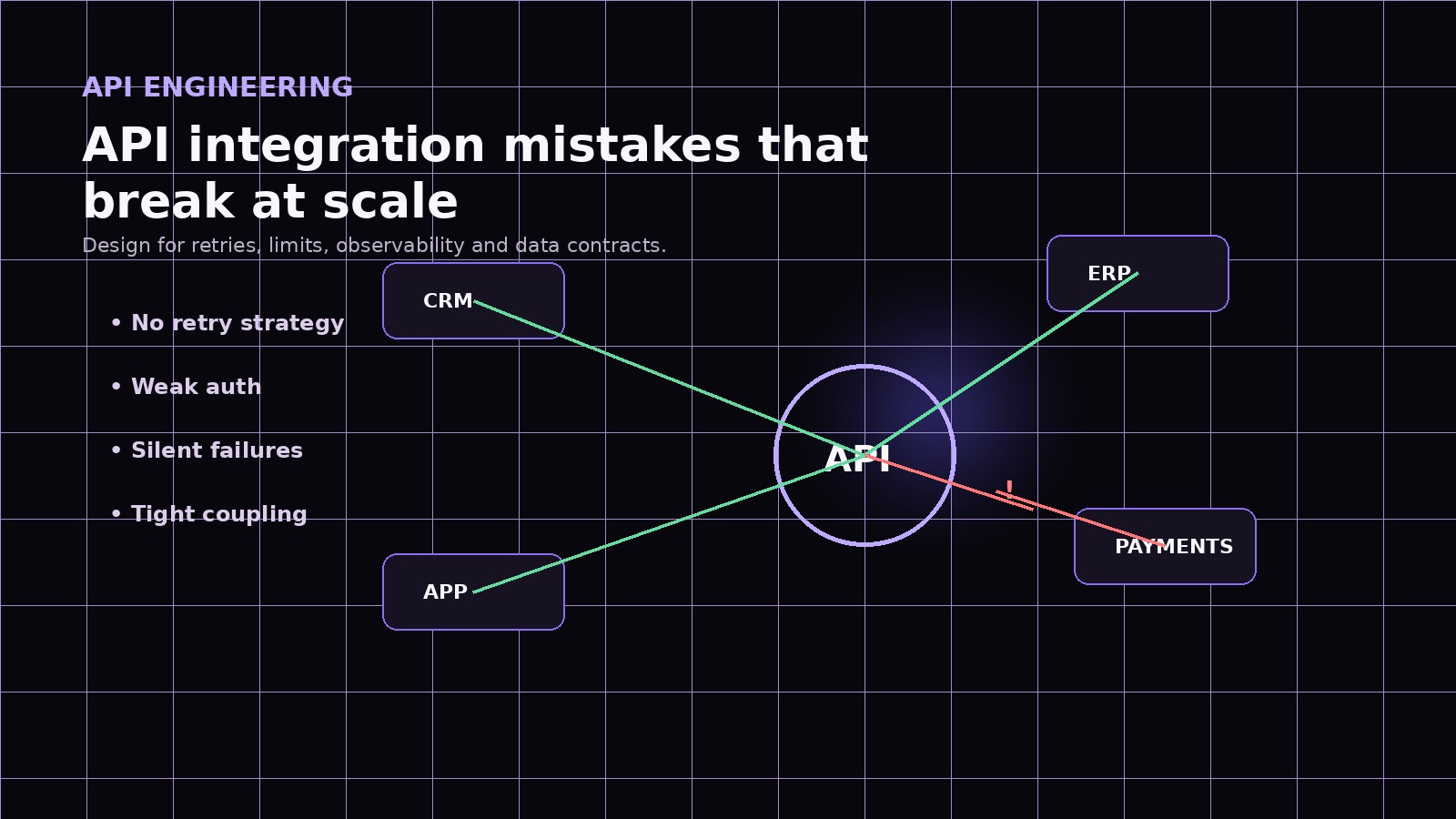
An API integration can appear successful long before it is production-ready.
The first test often looks simple: authenticate, send a request and receive the expected response.
Scaling problems appear later.
Networks fail. Vendors enforce rate limits. Records arrive in the wrong order. Tokens expire. Webhooks are delivered twice. External systems change fields.
Reliable integration architecture is designed for these conditions.
Mistake 1: assuming every request succeeds
External APIs are outside your control.
Requests may fail because of:
- Timeouts
- Temporary server errors
- Network interruptions
- Maintenance
- Rate limiting
The application should distinguish between temporary and permanent failures.
A retry can be appropriate for a timeout. It may be wrong for an invalid customer ID.
Blind retries can make an outage worse.
Use controlled retry strategies with limits and backoff.
Mistake 2: ignoring idempotency
Duplicate requests happen.
A payment request, order creation or webhook handler should not create duplicate business actions when the same event is processed twice.
Idempotency means the system can recognize that an operation was already completed.
This is critical for payments and financial workflows.
Mistake 3: building around undocumented assumptions
Developers sometimes assume a field will always be present or a status will never change.
Production data proves otherwise.
Define a clear contract for:
- Required fields
- Optional fields
- Allowed values
- Date formats
- Currency
- Identifiers
- Error responses
Validate incoming data before it reaches core business logic.
Mistake 4: weak authentication design
API keys placed directly in code are difficult to rotate and dangerous if the repository is exposed.
Credentials should be stored securely and separated by environment.
Use the provider's recommended authentication mechanism, which may include:
- OAuth
- Signed requests
- Short-lived tokens
- Service accounts
- Rotating secrets
Permissions should follow the principle of least privilege.
Mistake 5: not planning for rate limits
Many APIs restrict how many requests can be made during a period.
A system may work perfectly with ten customers and fail at ten thousand.
Review vendor rate limits before designing synchronization.
Strategies may include:
- Batching
- Queueing
- Caching
- Webhooks
- Incremental synchronization
- Request throttling
The architecture should avoid unnecessary requests.
Mistake 6: treating webhooks as guaranteed messages
Webhooks are useful because they reduce polling.
But they still need reliable handling.
A good webhook receiver should:
- Validate the signature
- Respond quickly
- Store the event
- Process asynchronously when possible
- Handle duplicate events
- Support retries
- Log failures
Do not perform a long chain of business operations before returning a response to the webhook provider.
Mistake 7: no observability
If an integration fails silently, operations teams discover the issue when customers complain.
Track:
- Failed requests
- Queue depth
- Processing delays
- Authentication errors
- Reconciliation differences
- Vendor response time
Logs should include enough context to understand what happened without exposing sensitive information.
Mistake 8: tight coupling between systems
If a CRM field changes and the entire application breaks, the integration boundary may be too fragile.
Use an internal model between external data and business logic where appropriate.
This creates a layer where external fields can be mapped and validated without spreading vendor-specific assumptions throughout the codebase.
Mistake 9: forgetting regional differences
Businesses operating across the USA, Canada and Middle East may integrate with different payment providers, tax systems, logistics companies and communication tools by region.
Do not assume the integration used in one market can simply be copied.
The product should separate regional providers from core business rules.
This makes expansion easier.
Mistake 10: no reconciliation process
Even reliable integrations can drift.
A reconciliation process compares records between systems and identifies mismatches.
Examples include:
- Payments vs orders
- ERP inventory vs eCommerce inventory
- CRM contacts vs customer accounts
- Subscription status vs access permissions
Reconciliation turns hidden data problems into visible operational tasks.
Build for failure from the beginning
The difference between a demo integration and a production integration is failure handling.
The first successful request proves that the API can be called.
Production architecture proves that the business can continue operating when something goes wrong.
That is the standard integrations should be designed to meet.