Most businesses do not need custom software on day one.
Standard tools are often the fastest and most sensible way to start. Spreadsheets, SaaS platforms, WordPress plugins, CRM systems and no-code automations can solve a large number of business problems.
The question is when those tools stop supporting the operation and start creating friction.
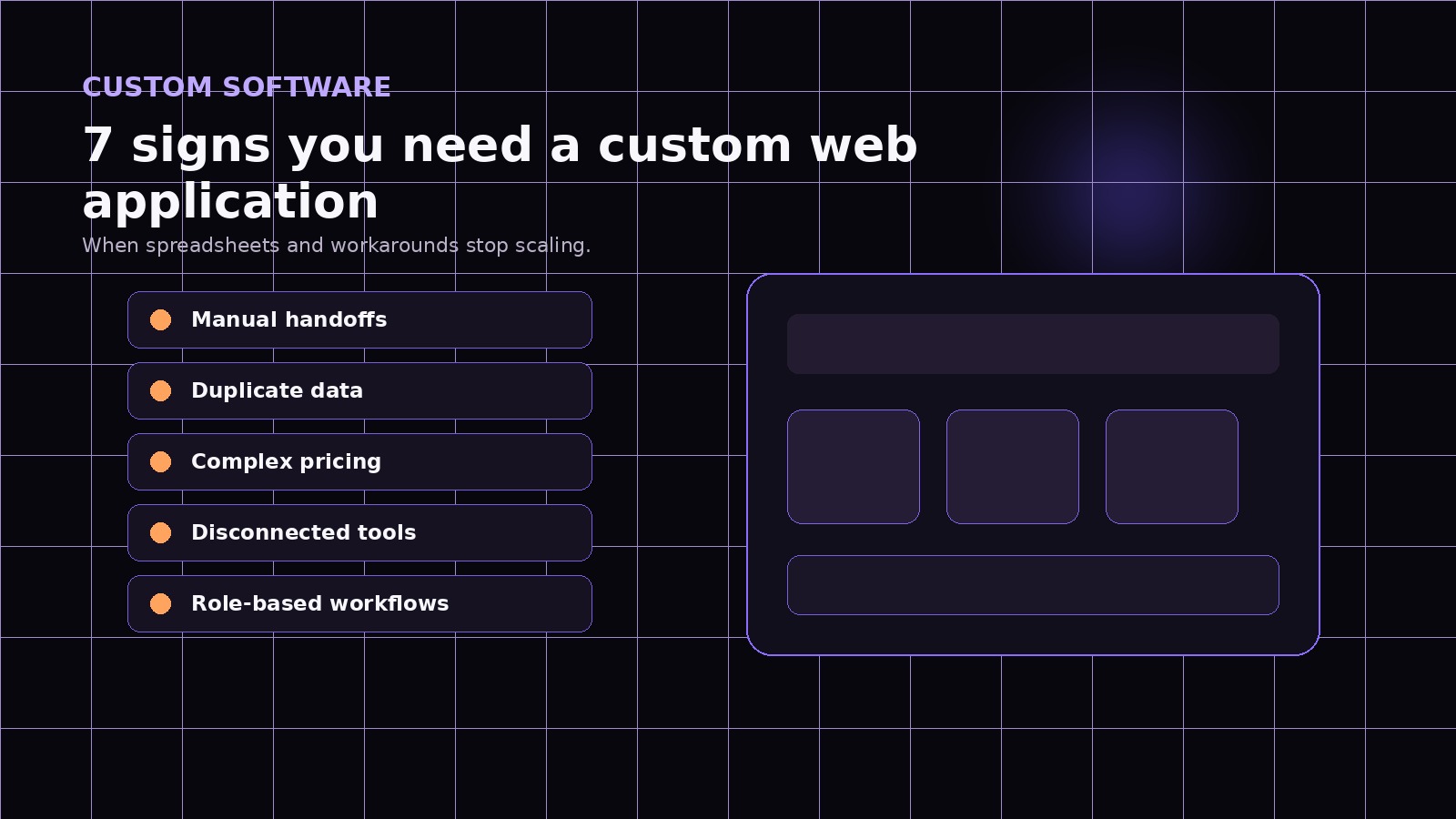
Here are seven signs we look for when evaluating whether a company should consider a custom web application.
1. Your team is rebuilding the same workflow manually
A repeated manual process is one of the clearest signals.
This may look like employees copying information from email into spreadsheets, then into a CRM, then into an accounting or operations system. The process technically works, but it depends on people remembering every step.
Manual work becomes expensive when volume increases.
A custom web application can centralize the process, validate required data and automate handoffs between teams.
2. Your business rules are too specific for standard software
Generic software works best for generic processes.
If your pricing, approval flow, customer permissions, booking rules or operational logic are unusual, teams often compensate with spreadsheets, custom fields and manual exceptions.
That can be manageable at low volume. At scale, the exceptions become the process.
A custom system makes sense when the unique rules are important enough that they should be expressed directly in software.
3. Important data exists in too many places
Disconnected data creates slow decisions.
A sales team may work in a CRM, finance in another platform, operations in spreadsheets and customers in a separate portal. The result is often conflicting information about the same order, customer or project.
Custom software does not necessarily replace every system. It can act as a shared workflow layer that connects the systems through APIs.
For companies in the USA, Canada and Middle East, this is a common integration problem as businesses adopt more specialized SaaS tools.
4. Customers need a portal rather than another email thread
Customer portals are a frequent reason to move toward custom development.
A portal can allow customers to:
- View orders or projects
- Upload documents
- Approve work
- Manage users
- Track service requests
- View invoices
- Download reports
- Communicate around structured workflows
If customers repeatedly ask your team for information that already exists internally, exposing the right information through a secure portal can improve both service and operational efficiency.
5. Different users need very different permissions
Complex permissions are difficult to manage with tools that were not designed for them.
A platform may need administrators, internal staff, partners, customers, vendors and managers—each with different access to records and actions.
When permissions become central to the product, a custom role and authorization model is often safer and easier to maintain than a collection of workarounds.
6. Integrations are becoming the product
Some businesses begin with one integration and gradually add five more.
Payments, CRM, ERP, logistics, identity providers, analytics, messaging, document services and partner APIs may all need to exchange data.
If the operation depends on these connections, the integration layer deserves proper architecture.
A custom web application can define how data moves, what happens when an external service fails, how retries work and how errors are monitored.
7. The limitations are affecting revenue or growth
This is the most important signal.
Custom software is an investment, so there should be a business reason for it.
Examples include:
- A sales process cannot support larger customers
- Manual operations require too much headcount
- Customers abandon a fragmented experience
- New regions cannot be supported cleanly
- Product ideas are blocked by platform limitations
- Data quality is affecting decisions
If software limitations are directly constraining revenue, efficiency or customer experience, the cost of doing nothing becomes easier to measure.
Custom does not mean building everything yourself
A good custom application still uses established services where appropriate.
Authentication, payments, cloud hosting, email delivery, analytics and other capabilities can often be provided by reliable platforms. The custom work should focus on the workflows that differentiate the business.
This reduces both risk and development time.
Regional growth makes architecture more important
Businesses expanding across the USA, Canada, Saudi Arabia, UAE and wider Middle East may face additional complexity around currencies, tax rules, language, payment methods, local integrations and operational ownership.
A system that was originally built for one market can become difficult to extend if these requirements were never considered.
That does not mean every platform needs global architecture on day one. It means the most likely growth scenarios should be discussed before the foundations are fixed.
The practical decision
We normally recommend custom web application development when three things are true:
1. The workflow is strategically important. 2. Existing software creates repeated friction or limitations. 3. The expected business value is large enough to justify ongoing product ownership.
If those conditions are not present, a configurable platform may still be the better choice.
Custom software should simplify the business—not become another system the business has to fight.