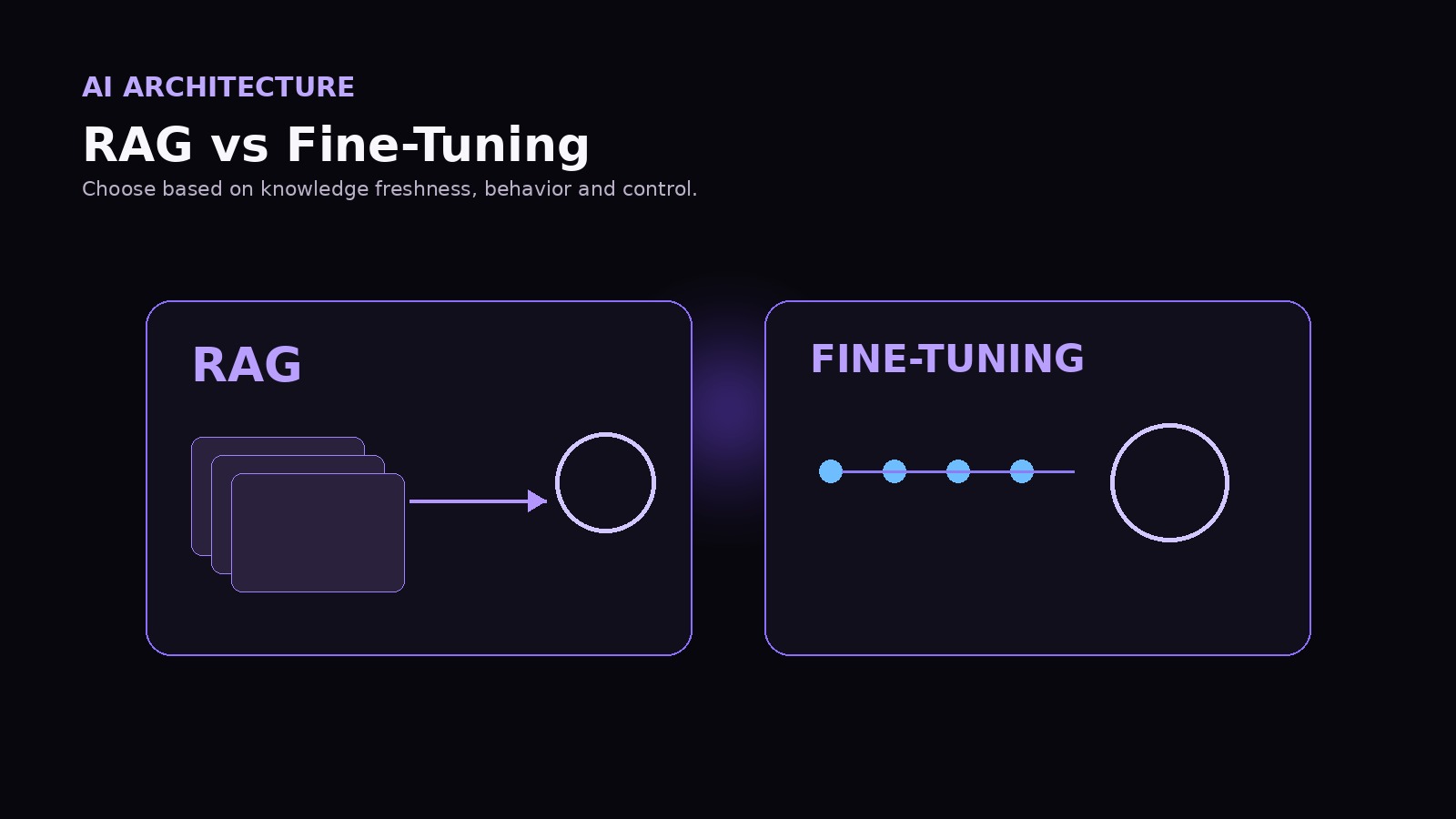
RAG and fine-tuning are often discussed as competing approaches, but they solve different problems.
Retrieval-Augmented Generation, usually called RAG, helps an AI system use external knowledge at the time a question is asked. Fine-tuning changes how a model behaves by training it further on selected examples.
The first question is therefore not “which is better?” It is “what problem are we trying to solve?”
What RAG is good at
A RAG system typically has three important parts:
1. A source of business knowledge 2. A retrieval layer that finds relevant information 3. A language model that uses that information to answer or complete a task
The knowledge may come from policies, product documentation, contracts, support articles, project files or structured data.
RAG is useful when information changes frequently.
For example, if a company updates its pricing, policies or internal documentation every week, the AI system should not need to be retrained every week. The knowledge can be updated in the source system and retrieved when needed.
This is why RAG is common in:
- Internal knowledge assistants
- Customer support assistants
- Document search
- Policy and compliance lookup
- Product knowledge systems
- Sales enablement tools
What fine-tuning is good at
Fine-tuning is more appropriate when the goal is to influence behavior, format or task specialization.
Examples include:
- Producing responses in a specific structure
- Learning a specialized classification task
- Following a consistent domain-specific output style
- Improving performance on repeated examples of a narrow task
- Reducing the amount of prompt instruction needed for a known workflow
Fine-tuning is not the best way to keep business facts current.
If the model needs today's inventory, current pricing or the latest internal policy, that information should normally come from a live system or retrieval layer.
A simple way to think about the difference
Use RAG when the model needs to know something current.
Use fine-tuning when the model needs to behave in a more specialized way.
That distinction is not perfect, but it is useful in early architecture discussions.
Accuracy depends on more than the model
Businesses sometimes focus heavily on model selection while ignoring the quality of the surrounding system.
A RAG implementation can fail even with a strong language model if:
- Documents are poorly structured
- Retrieval returns irrelevant chunks
- Permissions are ignored
- Old documents remain searchable
- Metadata is missing
- The application does not cite or validate important answers
Similarly, a fine-tuned model can fail if the training examples are inconsistent or too narrow.
AI architecture is still software architecture.
RAG is usually easier to update
For business applications, this is a major advantage.
If a legal team replaces a policy document, the system can index the new document. If a product catalog changes, the integration can make the new information available.
This matters for companies operating across multiple markets.
A business serving the USA, Canada and Middle East may have different documentation by region. RAG can use metadata and access rules to retrieve the right source for the right user.
For example, an employee in Canada may need a Canadian policy, while a customer in the UAE may need region-specific product or service information.
Fine-tuning requires stronger dataset discipline
Fine-tuning is not simply uploading documents into a model.
The training data should represent the task the model is expected to perform.
If the task is classification, examples should demonstrate correct classification. If the task is structured generation, examples should demonstrate the exact output behavior.
The quality and consistency of the dataset strongly influence the result.
This makes fine-tuning appropriate when the organization has a repeatable task and enough examples to define good behavior.
Can you use RAG and fine-tuning together?
Yes.
A production AI system may use:
- RAG for current business knowledge
- Fine-tuning for specialized output behavior
- Tools or APIs for live actions
- Guardrails for permissions and validation
The application can combine these capabilities depending on the workflow.
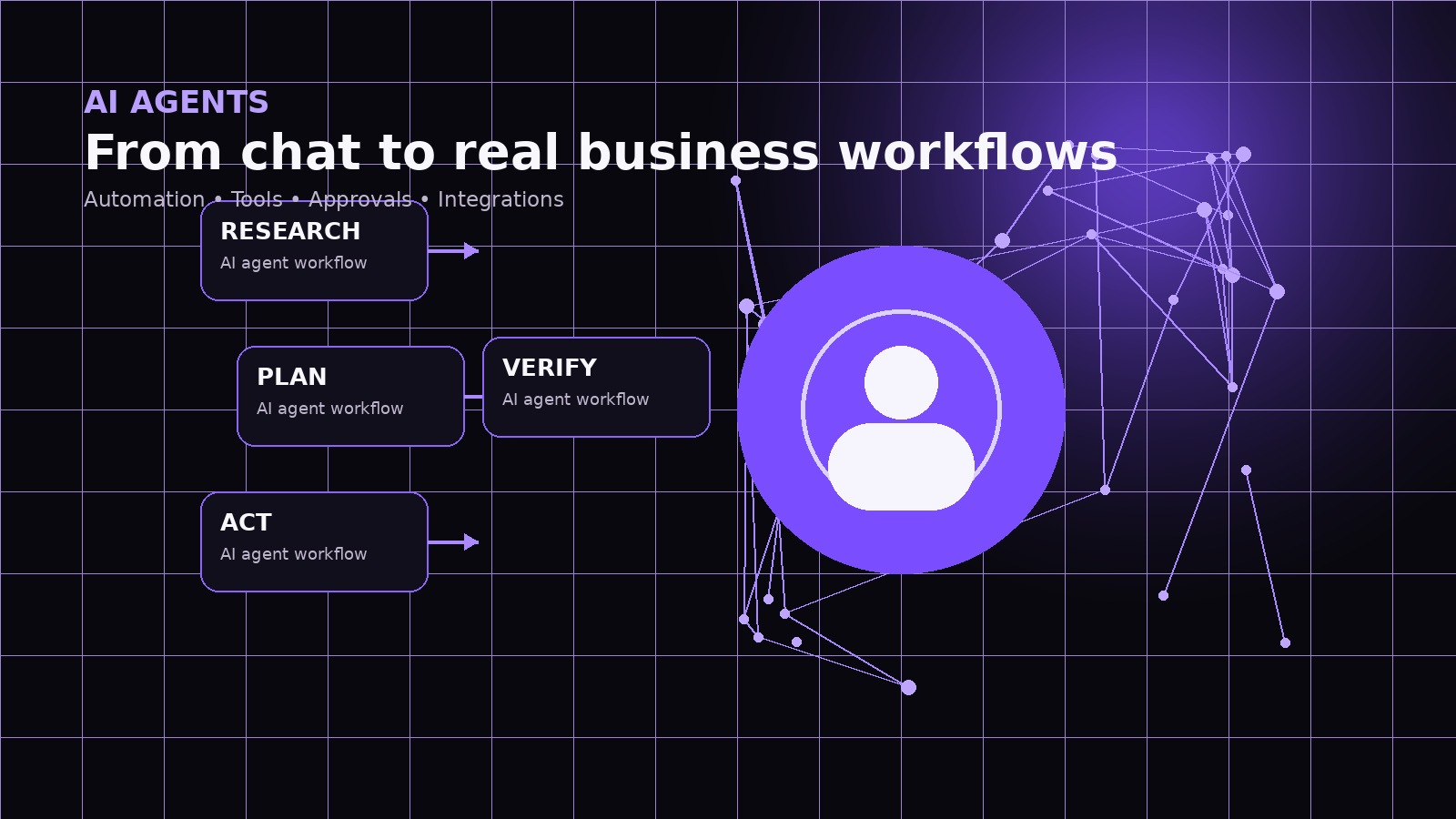
For example, an AI agent might retrieve an internal policy using RAG, produce a structured recommendation using a fine-tuned behavior pattern, and then create a draft ticket through an API.
What about cost?
The total cost is not determined only by model usage.
For RAG, costs may include document processing, embeddings, vector storage, search infrastructure, permissions and evaluation.
For fine-tuning, costs may include dataset preparation, training, evaluation, version management and ongoing monitoring.
The right architecture should minimize unnecessary complexity.
If a strong prompt and a clean API call solve the problem, neither RAG nor fine-tuning may be necessary.
Our recommendation
Start with the workflow.
Ask:
- Does the AI need current private knowledge?
- Does that knowledge change frequently?
- Is the problem about facts or behavior?
- Are there enough examples to define the desired behavior?
- Does the system need citations or source traceability?
- What happens if the answer is wrong?
For many enterprise and mid-market AI projects, we start with RAG because businesses already have knowledge that needs to be used safely. Fine-tuning is introduced when repeated evaluation shows a clear behavior problem that training can improve.
The architecture should earn its complexity.