There is no useful single price for custom software.
A booking platform, an internal workflow tool and a multi-tenant SaaS product may all be described as “custom software,” but the engineering effort can be completely different.
For companies budgeting projects in the USA, Canada, UAE, Saudi Arabia or wider Middle East, the better approach is to understand the cost drivers before comparing vendor quotes.
Scope is the largest variable
The number of screens is not enough to estimate a product.
Two applications with twenty screens can require very different effort depending on what happens behind those screens.
Important scope questions include:
- How many user roles exist?
- What permissions does each role have?
- Is there payment processing?
- Are subscriptions required?
- Does the product support multiple organizations or tenants?
- Are there complex approval workflows?
- Does it integrate with external systems?
- Does the platform need real-time features?
- Are reports or dashboards required?
- Does it need mobile apps as well as web access?
A reliable estimate begins with behavior, not page count.
Integrations can change the budget quickly
Integrations are often underestimated.
Connecting to a payment provider with a clean, documented API is very different from synchronizing data with a legacy ERP that has inconsistent records and limited documentation.
Integration effort includes more than making the first API request.
The system may need:
- Authentication
- Data mapping
- Retry logic
- Webhooks
- Rate-limit handling
- Error monitoring
- Reconciliation
- Security controls
- Sandbox and production configuration
The more the software depends on external systems, the more integration architecture affects cost.
Product maturity affects the team
An early prototype can often be built with a small team.
A production platform serving paying customers may require:
- Product or business analysis
- UX/UI design
- Frontend engineering
- Backend engineering
- QA
- DevOps or cloud support
- Security review
- Project or delivery management
The team structure should match the risk of the product.
For an internal tool with twenty users, the operational expectations may be different from a platform processing customer transactions across several countries.
USA and Canada: common budget drivers
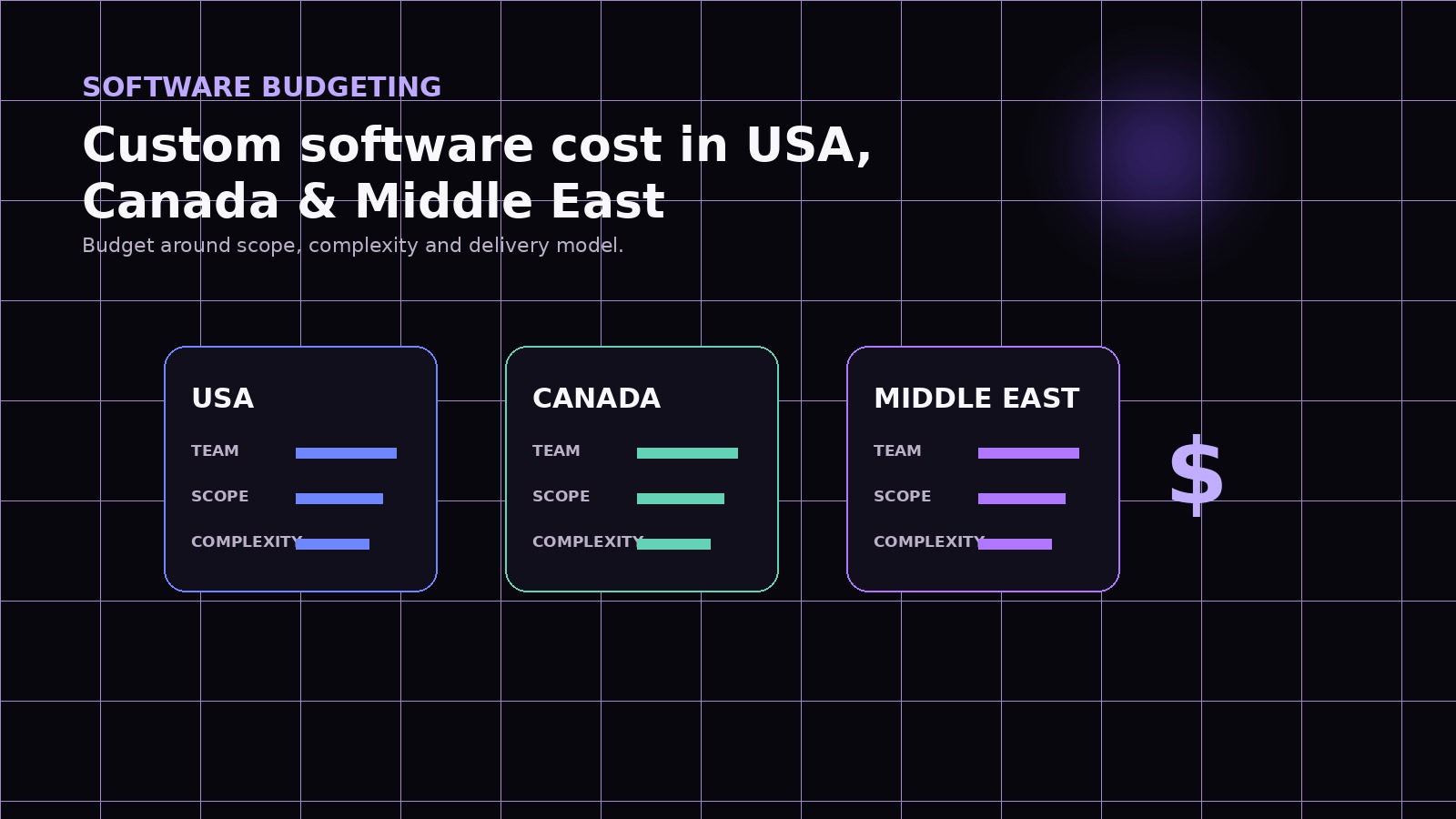
Projects in the USA and Canada often place strong emphasis on integrations, SaaS workflows, analytics, accessibility, security and ongoing product iteration.
The cost is influenced by whether the company hires locally, uses a blended onshore/offshore team or works with a remote product partner.
A higher hourly rate does not automatically mean a higher total cost. Senior teams may reduce rework by making better architecture decisions earlier.
The relevant metric is the cost of getting to a stable business outcome.
Middle East: localization and operational complexity
Projects in the Middle East, particularly Saudi Arabia and the UAE, may require additional planning around:
- Arabic and English interfaces
- Right-to-left layouts
- Local payment methods
- VAT handling
- Regional hosting expectations
- Government or identity integrations
- Local logistics
- Multiple business entities
These requirements should be included during discovery rather than treated as late-stage additions.
A bilingual product, for example, affects layout, content management, QA and sometimes data models.
The delivery model also matters
There are several common engagement models.
Fixed scope
A fixed-scope project works best when requirements are stable and acceptance criteria can be defined clearly.
Time and materials
Time and materials is useful when the product will evolve through discovery and iteration.
Dedicated team
A dedicated product team is often more suitable for an ongoing roadmap where priorities change over time.
The commercial model should match the uncertainty in the product.
Trying to force an evolving SaaS product into a rigid fixed-price contract can create conflict instead of cost control.
Cost should include ownership after launch
The launch budget is only one part of the investment.
Plan for:
- Hosting
- Monitoring
- Backups
- Security updates
- Third-party services
- Support
- Product improvements
- Analytics
- New integrations
- Dependency upgrades
A well-designed application should reduce avoidable maintenance, but every real product needs ongoing ownership.
Use ranges only after discovery
We avoid publishing universal price lists because they encourage false comparisons.
A useful budget range should come after a short discovery process that defines:
- Core users
- Critical workflows
- Integrations
- Technical constraints
- Expected traffic
- Security requirements
- Launch priorities
This gives both the client and development partner a better basis for planning.
The cheapest quote can be the most expensive option
Software costs increase when the first version must be rebuilt.
Common causes include:
- Weak architecture
- No automated testing
- Poor documentation
- Hard-coded business rules
- Security shortcuts
- Inflexible integrations
- Inconsistent UI patterns
A project should be evaluated on delivery quality, not only initial price.
Whether you are building in the USA, Canada or Middle East, the best budget is the one connected to a clear scope and measurable business outcome.