AI agents are becoming a popular answer to almost every automation question.
That is a mistake.
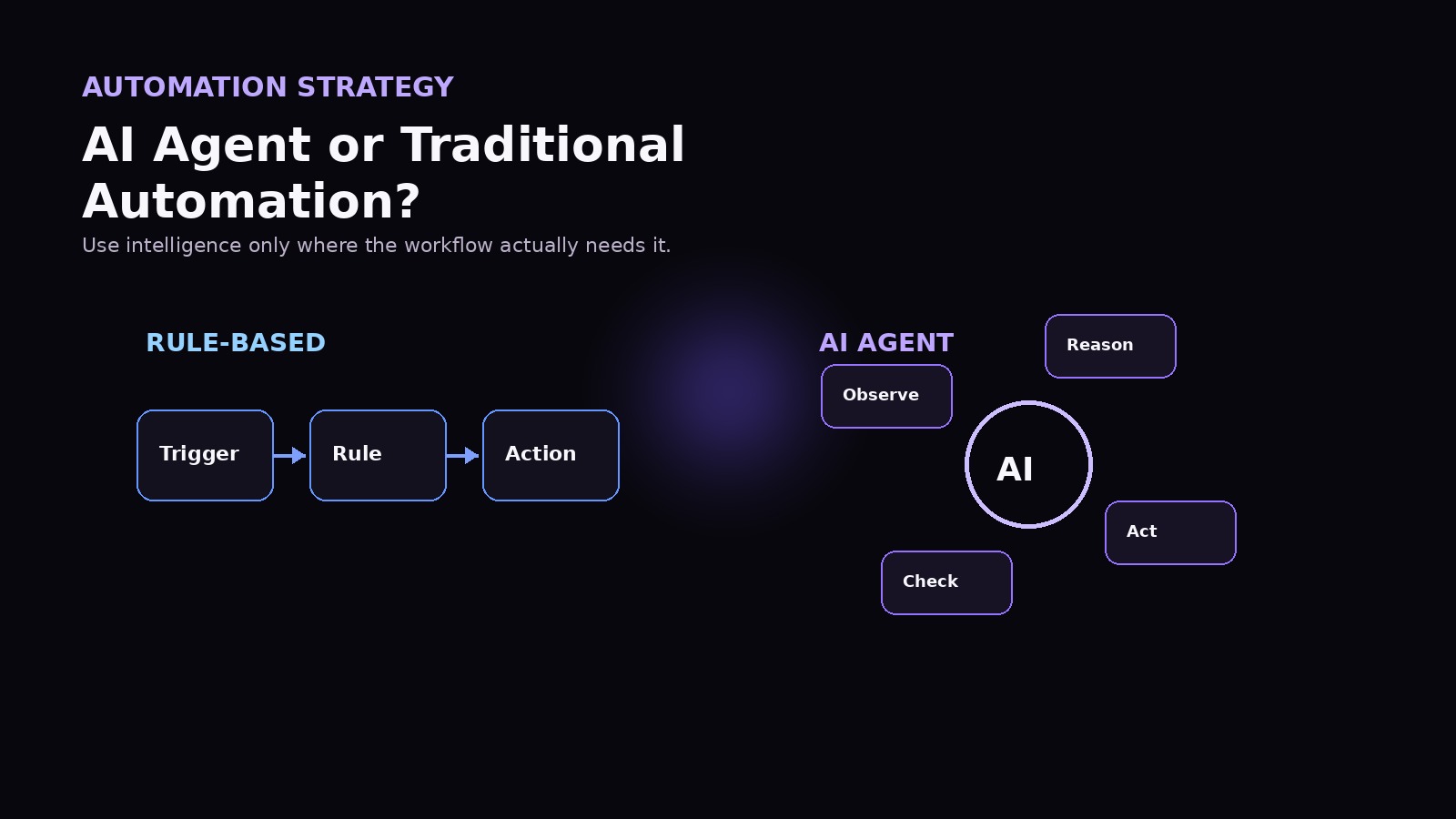
Many business processes are still better served by traditional deterministic automation. AI should be introduced when the workflow contains ambiguity, unstructured information or decisions that cannot be expressed cleanly as simple rules.
The architecture should match the problem.
Traditional automation is predictable
Traditional automation follows defined logic.
For example:
- When a payment succeeds, create an invoice.
- When inventory drops below a threshold, notify purchasing.
- When a form is submitted, create a CRM lead.
- When an order ships, send a tracking email.
These workflows do not need a language model.
They benefit from deterministic behavior. The same input should produce the same expected action.
Traditional automation is easier to test, monitor and audit.
AI agents are useful when interpretation is required
An AI agent becomes useful when the workflow includes information that cannot be handled with simple rules.
Examples include:
- Reading a customer message and understanding intent
- Reviewing a document before deciding which workflow applies
- Searching multiple knowledge sources
- Selecting the right tool based on context
- Creating a plan from an open-ended request
- Producing a draft recommendation for a human reviewer
The AI is valuable because the input is less structured.
An agent should not have unlimited authority
A production agent should operate inside boundaries.
We define which tools it can use, what information it can access and which actions require approval.
For example, a support agent might be allowed to:
- Read customer history
- Search internal policy
- Draft a response
- Recommend a refund
But the actual refund may still require a person to approve it.
This is especially important in financial, legal, healthcare or high-value operational workflows.
The hybrid model is often strongest
Real systems frequently combine both approaches.
AI may interpret the request, while deterministic software executes the final action.
Consider an inbound sales email.
An AI component can classify the opportunity, summarize requirements and extract company information. A traditional workflow can then validate required fields, create the CRM record and assign it to the correct sales team.
This gives the business flexibility without making every step probabilistic.
Ask whether rules can solve the problem first
Before building an agent, ask:
- Can the decision be written as a clear rule?
- Is the input structured?
- Does the action need to be reproducible?
- Is the cost of an incorrect decision high?
- Does the workflow require language understanding?
- Does the system need to choose among several tools?
If rules solve the problem, use rules.
AI complexity should be earned.
Regional businesses often need mixed workflows
Companies operating across the USA, Canada and Middle East may process requests in different languages, formats and business contexts.
AI can help normalize this variability.
For example, a regional service company may receive customer requests by email, web form and WhatsApp. The language and structure vary, but the downstream CRM workflow is standardized.
An AI layer can interpret the request and extract structured information. Traditional automation can then handle routing, notifications and record creation.
Measure the automation before expanding it
A good AI agent project should have measurable outcomes.
Track metrics such as:
- Time saved per task
- Percentage of cases handled without escalation
- Error rate
- Human correction rate
- Response time
- Cost per completed workflow
Without measurement, it is difficult to know whether the agent is improving the process or simply making it more impressive.
Start narrow
The best first agent is usually not a general-purpose employee.
It is a focused system for one workflow.
Examples include:
- Support ticket triage
- Proposal preparation
- Document intake
- Knowledge lookup
- Lead qualification
- Internal research
Once the system performs well and controls are proven, additional tools can be introduced.
The practical rule
Use traditional automation for predictable logic.
Use AI for interpretation.
Use an agent when AI must coordinate several steps or tools.
And use human approval whenever the business risk justifies it.
That architecture is less fashionable than “AI everywhere,” but it is more reliable.