A custom web application rarely stays exactly as it was on launch day. New integrations appear, customers ask for mobile access, reporting requirements expand and internal teams want to connect the platform to other systems.
API-first architecture helps prepare for that reality.
The basic idea is straightforward: important business capabilities are exposed through well-defined APIs instead of being tightly coupled to one user interface.
One backend, multiple experiences
Imagine a platform that initially launches as a web application. A year later, the business wants a mobile app and a partner portal.
With a tightly coupled architecture, significant business logic may exist inside the original web interface. The new products can end up rebuilding the same rules.
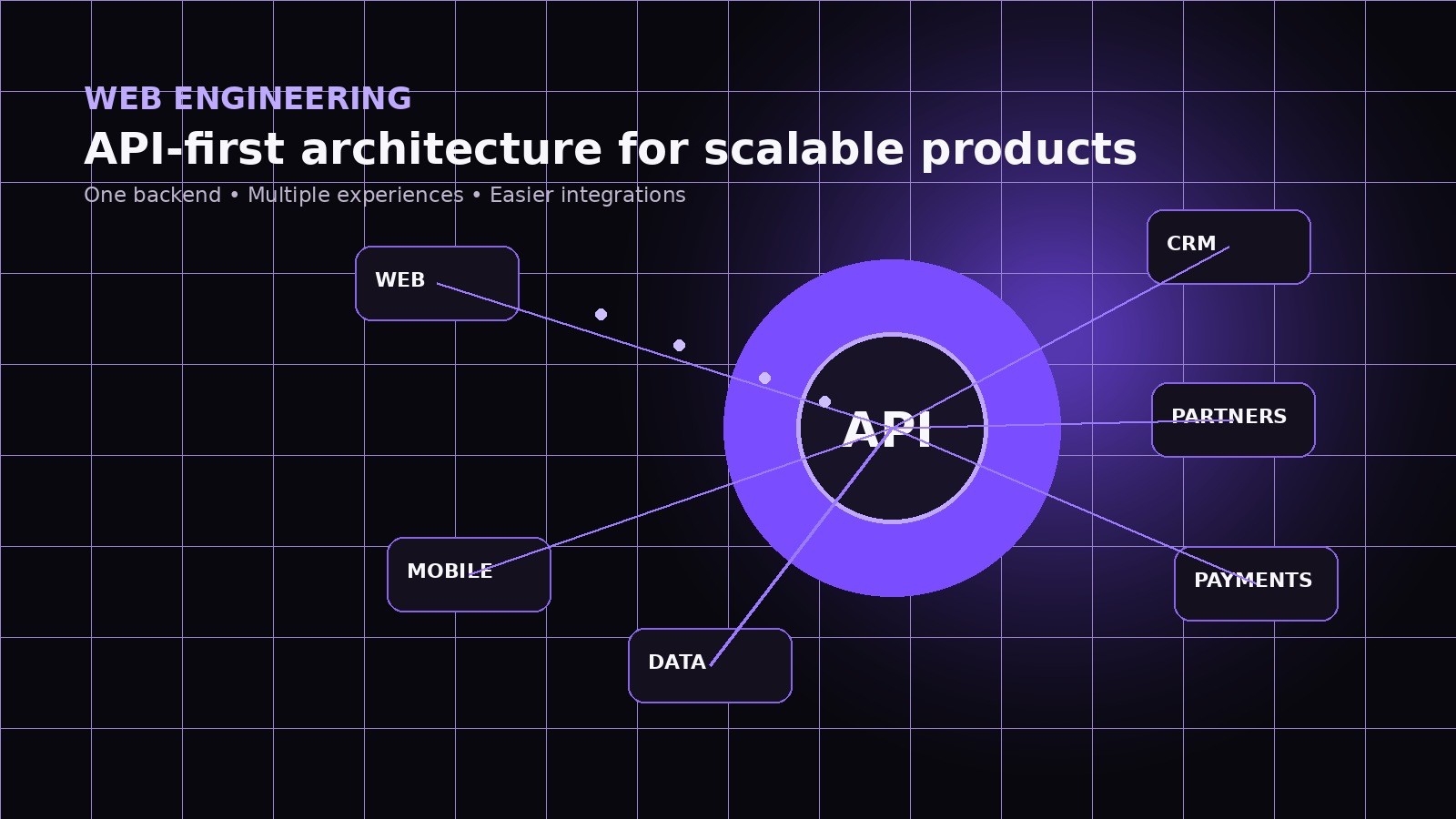
With an API-first approach, the web application, mobile app and partner portal can consume the same backend capabilities.
This creates a clearer separation between what the system does and how a user interacts with it.
Integrations become easier to manage
Modern software rarely operates alone. A custom platform may need to exchange data with payment providers, accounting systems, CRMs, marketing tools, logistics platforms or customer applications.
A consistent API layer gives these integrations a defined entry point.
That does not automatically make integrations simple, but it improves maintainability. Authentication, validation, permissions and error handling can be managed consistently instead of being recreated for every connection.
Teams can work more independently
Separating frontend and backend responsibilities can also improve delivery.
A frontend team can work against documented API contracts while backend engineers implement the underlying services. Mobile developers can use the same API without needing to understand how the web interface was constructed.
This becomes particularly valuable as a product and engineering team grows.
API-first does not mean microservices everywhere
It is important not to confuse API-first design with unnecessary architectural complexity.
A small or medium application can still use a well-structured monolithic backend while exposing clean APIs. Microservices are useful in specific situations, but they introduce deployment, monitoring and operational overhead.
The goal is not to maximize the number of services. The goal is to create clear boundaries and predictable interfaces.
Security should be designed into the API
An API can expose valuable business capabilities, which means authentication and authorization cannot be treated as an afterthought.
Production APIs should consider:
- Strong authentication
- Role and permission checks
- Request validation
- Rate limiting
- Audit logging
- Secure handling of sensitive data
- Monitoring and alerting
These controls become increasingly important when the API is used by mobile apps or third-party systems.
Design for realistic growth
API-first architecture is most valuable when it is driven by realistic product needs.
If a business expects mobile apps, partner integrations, multiple interfaces or significant automation, defining a clean API layer early can reduce future rework.
At KoderNext, we use architecture as a tool for business flexibility. The best technical design is not necessarily the most complicated one. It is the design that makes today's product reliable while keeping tomorrow's most likely changes manageable.