AI adoption is entering a more practical stage. Businesses are increasingly looking beyond standalone chatbots and asking a more important question: can AI actually complete useful work inside our existing processes?
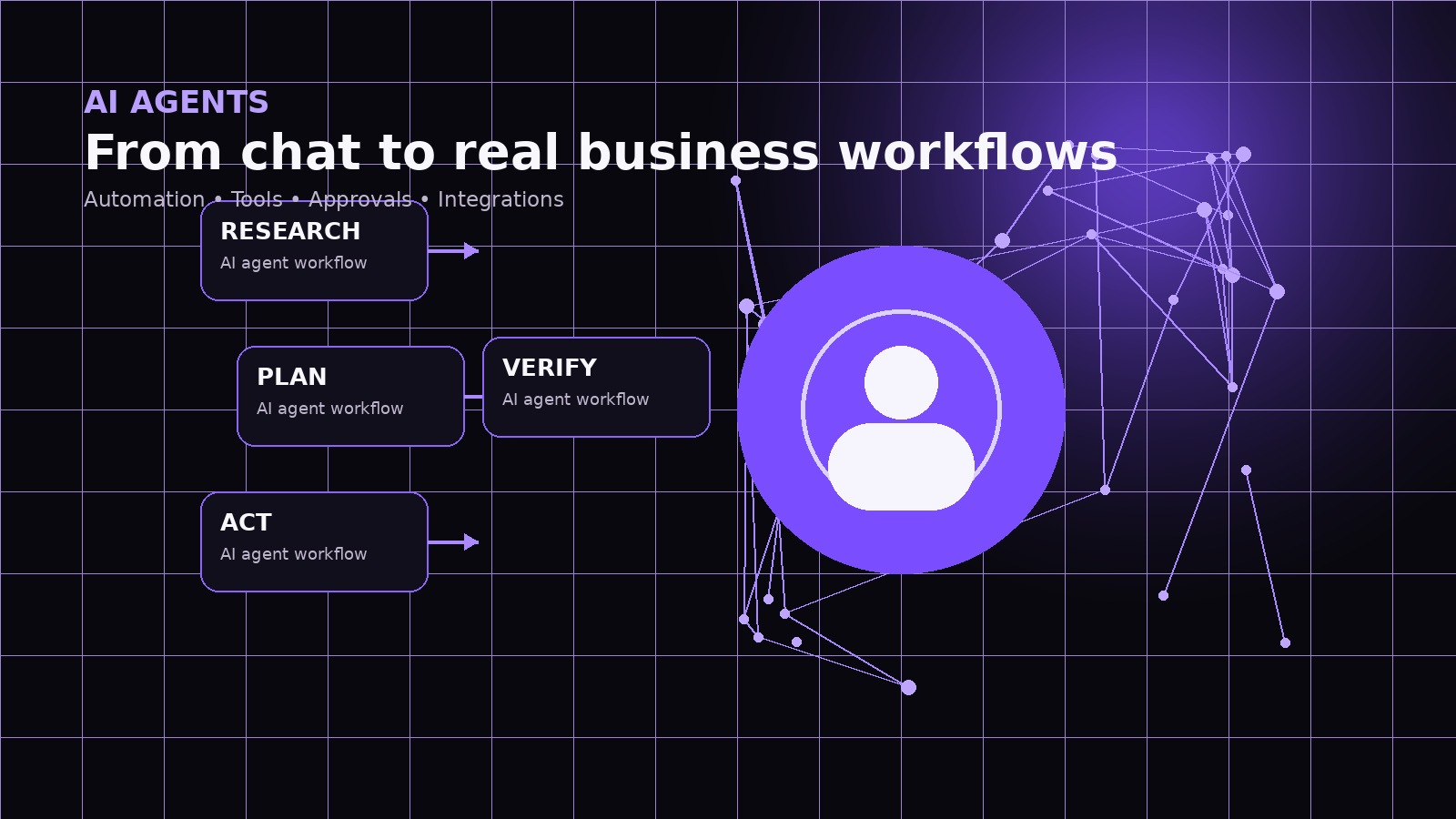
That is where AI agents become interesting. An agent is not simply a chatbot with a different name. A well-designed agent can understand an objective, decide which approved tools or data sources it needs, perform a sequence of actions, and return a result for review.
From answering questions to completing workflows
Traditional generative AI applications usually start with a prompt and return text. That can be useful for drafting, summarizing or answering questions, but many business processes require multiple steps.
A support workflow, for example, may require the system to identify a customer, retrieve an order, check internal policies, classify the issue, draft a response and create a ticket. An AI agent can coordinate these steps when it is connected safely to the relevant systems.
Useful examples include:
- Qualifying inbound sales leads and updating a CRM
- Summarizing support conversations and creating follow-up tasks
- Searching internal knowledge bases before drafting customer responses
- Reviewing documents and extracting structured information
- Preparing reports from multiple business systems
- Routing requests to the right human team based on context
The value comes from reducing repetitive work while keeping people in control of important decisions.
Good AI agents need boundaries
The strongest agent architecture is not the one that gives AI unlimited access. It is the one that gives the model exactly the permissions it needs.
For a production system, we normally think about four layers: the model, business data, tools or APIs, and control rules.
Those control rules matter. They can determine which actions are automatic, which require human approval, what data can be accessed and what should be logged for audit purposes.
For example, an agent might be allowed to draft a refund recommendation but require a human to approve the actual refund. This creates speed without handing over unnecessary authority.
Start with one measurable workflow
Businesses sometimes begin AI projects with a broad objective such as “we need an AI assistant.” A better starting point is to identify one repeated workflow with a measurable cost.
Ask:
- How often does this task happen?
- How much staff time does it consume?
- What information is required to complete it?
- Which systems are involved?
- What is the cost of an incorrect action?
- Where should a person remain in the loop?
A narrow workflow makes it easier to test accuracy, calculate return on investment and improve the system before expanding it.
Integration matters as much as the model
For many companies, the difficult part of an AI project is not selecting a language model. It is connecting AI securely with the systems that already run the business.
That may include CRMs, ERPs, eCommerce platforms, support systems, databases, document repositories or custom APIs.
This is why an AI initiative should be treated as a software engineering project rather than simply a prompt-engineering exercise. Authentication, permissions, error handling, monitoring and data quality all influence the final result.
The practical opportunity
AI agents can create significant value, but the best opportunities are usually less dramatic than the marketing suggests. They automate parts of real workflows, remove repetitive steps and give teams faster access to useful information.
At KoderNext, we recommend starting with a clearly defined process, connecting only the systems required for that process, and building measurable controls around the agent from day one.
The goal is not to replace every workflow with AI. The goal is to identify where intelligence and automation can make a business process faster, easier and more reliable.